

Events
Registration required even by CU/BC ID holders
Cosponsors
- The Society of Fellows and Heyman Center for the Humanities
- Institute for Social and Economic Research and Policy
- Institute of Latin American Studies
- University of Pennsylvania, Center for Latin American and Latinx Studies
- University of Pennsylvania, Department of History
- Washington Brazil Office
Organizer
- Department of History
Contact
email address [email protected]
Notes
- Free and open to the public
- Registration required.
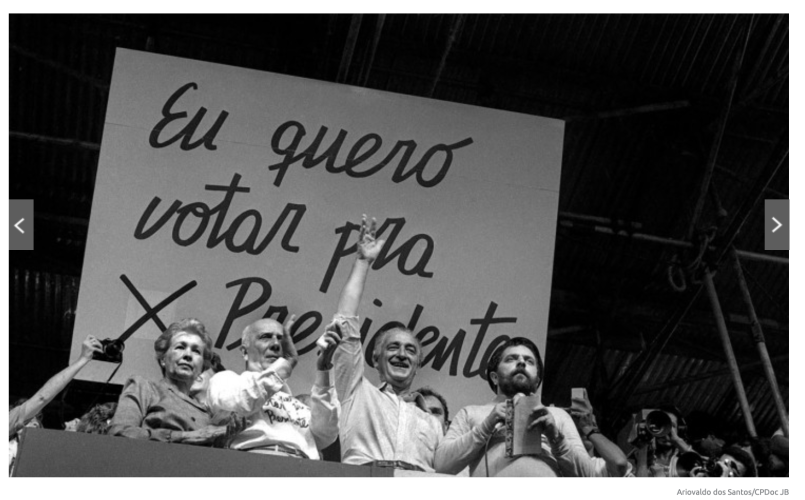
Join us for a conference marking the 40th anniversary of Brazil's return to democracy after 21 years of military-civilian dictatorship. We will explore the convergence of political, social, and economic transitions that defined this period, situating it within the broader regional history of authoritarianism in Latin America. The conference will examine how pro-democracy movements advocating for racial justice, human rights, and government accountability emerged at the municipal level, often preceding their influence on national politics. We aim to reevaluate how law functioned both as an instrument of state violence and as a tool leveraged by marginalized groups to advocate for their basic needs, thereby expanding the meaning of citizenship. The event will also reflect on key historiographical debates that illuminate the complex relationship between law, democracy, and violence in Latin America. Marking 40 years since Brazil’s return to democracy offers a critical opportunity to examine the very ideas of “transition” and “democratization.” Using Brazil as a focal point, we will also explore the intertwined, recent histories of nations emerging from dictatorships across the Americas in the context of current global political challenges.
Speakers
- Amy Chazkel, Columbia University
- Barbara Weinstein, New York University
- Claudio Lomnitz, Columbia University
- Daniela Traldi, Columbia University
- Jacob Blanc, McGill University
- James N. Green, Brown University (Emeritus)
- Juan Ignacio Arboleda, University of Pennsylvania
- Keisha-Khan Perry, University of Pennsylvania
- Kendall Thomas, Columbia University
- Larissa Rosa Correa, PUC-Rio and Harvard University
- Mariana Cavalcanti, Universidade do Estado do Rio de Janeiro and Columbia University
- Martha S. Jones, Johns Hopkins University
- Melissa Teixeira, University of Pennsylvania
- Oscar Vilhena Vieira, Fundação Getulio Vargas
Please email [email protected] to request disability accommodations. Advance notice is necessary to arrange for some accessibility needs.
Program
time9:15am EDT
Breakfast and coffee
time9:45am EDT
Introductions & Opening Remarks
time10:00am EDT
Rethinking the Narrative: A Historiographical Conversation
Barbara Weinstein
New York University
James N. Green
Brown University, Emeritus
Daniela Traldi
Society of Fellows
Columbia University
time11:30am EDT
Panel 1: Political, Social, and Economic Transitions
Moderator and Discussant
Melissa Teixeira
University of Pennsylvania
Organized Crime and Governmentality: Questions for the Periodization of Contemporary Brazilian History
Claudio Lomnitz
Columbia University
European Worker-Priests in Brazil: Catholic Activism, Resistance and International Solidarity during the Military Dictatorship
Larissa Rosa Correa
PUC-Rio and Harvard University
Memory as Transition: Life History and Self-Narration in the Time of Impunity
Jacob Blanc
McGill University
time1:15pm EDT
Lunch
time2:15pm EDT
Cities, Violence, and Democracy in Brazil
Moderator and Discussant
Amy Chazkel
Columbia University
Keisha-Khan Perry
University of Pennsylvania
Mariana Cavalcanti
Tinker Visiting Scholar
Columbia University
time3:45pm EDT
Coffee Break
time4:00pm EDT
Keynote: Constitutional Resilience
Oscar Vilhena Vieira, Fundação Getulio Vargas
Fundação Getulio Vargas
time5:15pm EDT
Roundtable Panel: Democracy and Race in the Americas
Moderator
Juan Ignacio Arboleda
University of Pennsylvania
Kendall Thomas
Columbia University
Martha Jones
Johns Hopkins University
time6:30pm EDT